


Homeowner Guide · Charlotte, NC
Can I build a garage on my lot?
Charlotte zoning, made simple. The five rules that decide where a detached garage can go, and how big and tall it can be, in Neighborhood 1 (N1) zoning districts.
How much of your lot can have buildings on it
Charlotte limits building coverage, not total paved area. Only roofed buildings count: your house, the garage, sheds. Driveways, patios and walkways don’t.
Example: 8,750 sq ft lot
How big the garage can be
All accessory buildings together (garage, sheds, workshops) can’t be larger than the heated square footage of your home’s first floor. Existing sheds and outbuildings count toward that limit. A garage apartment that qualifies as an ADU doesn’t count toward this limit.
How height is measured
Height runs from the average ground level around a building’s base to its highest point.
The house and garage are each measured from their own ground level. On a sloped lot, you compare measured heights, not which roof sits higher on the hill.
A home with a walkout basement or exposed foundation usually measures taller than it looks from the street, which can give the garage more room.
How close to the property line
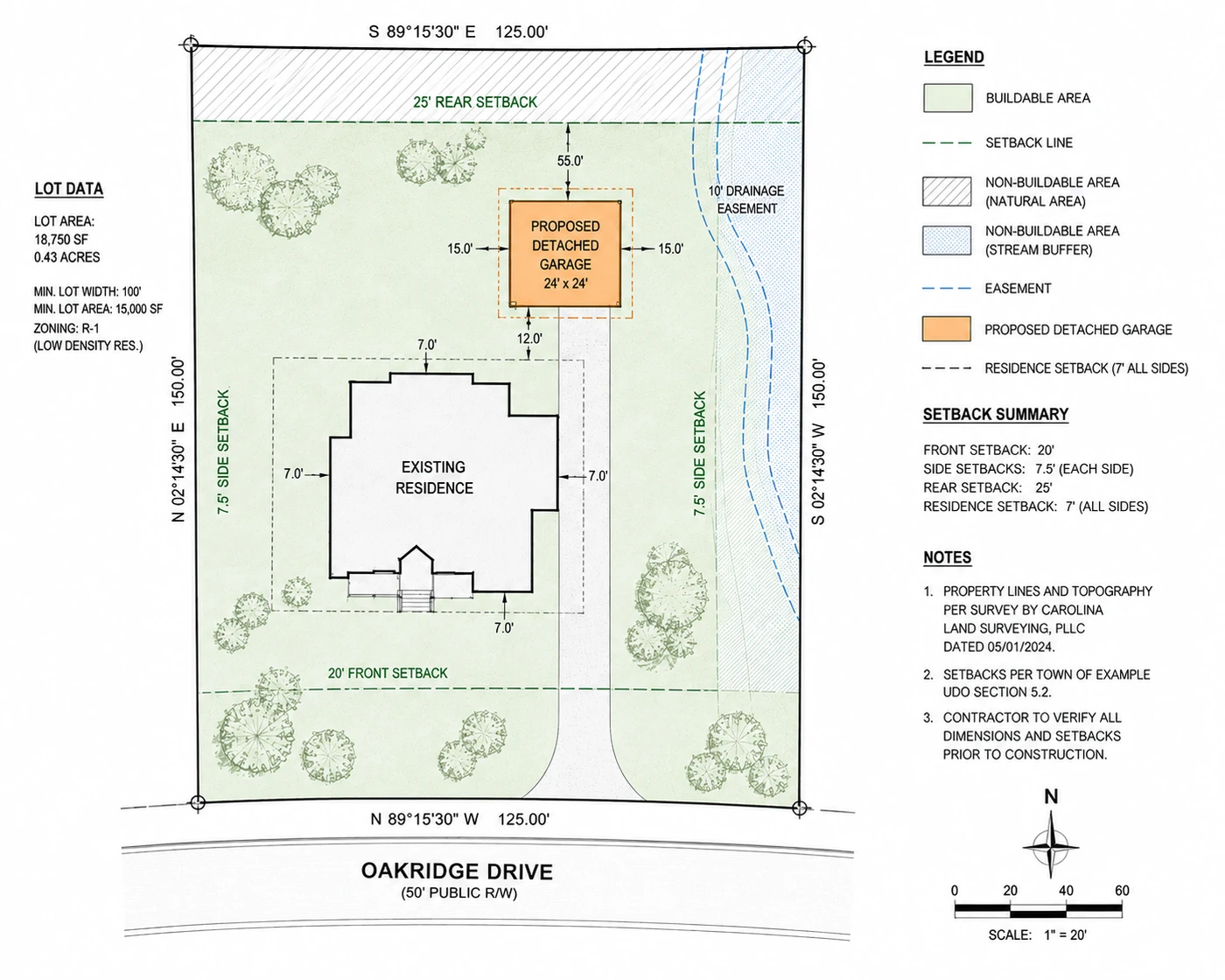
From side and rear property lines, when the garage is under 24 ft tall.
From the rear line, plus the full side setback for your district, when the garage is 24 ft or taller.
Garages generally can’t go in the front-yard setback or a corner lot’s street-side setback. Deep-set homes are an exception we can check for you.
Planning living space above?
A garage apartment with its own kitchen and bathroom counts as an accessory dwelling unit (ADU), and ADUs have additional rules.
What we’ll need from you
- Your property survey
- Your address
- Living space above the garage?
Not sure about your lot?
Carolina Garage Crafters will check it for free.
Based on the City of Charlotte Unified Development Ordinance for Neighborhood 1 (N1) districts. Rules can change; every project is verified with the city before permitting.